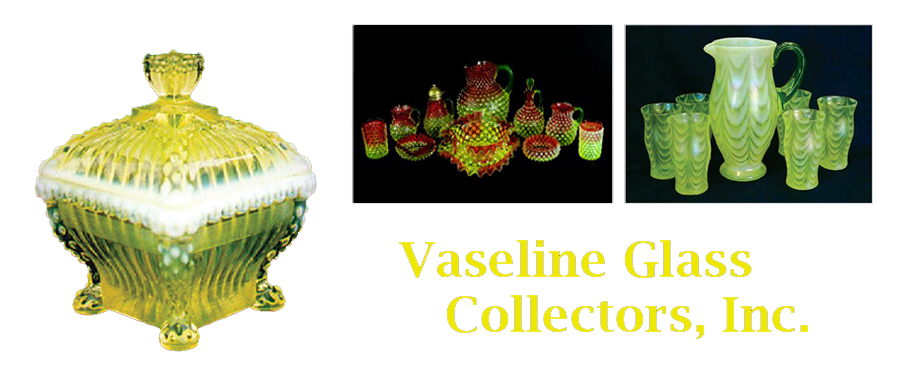

Yellow
to yellow-green glass that turns florescent bright green (under UV
light)
is the only true verification of
Vaseline Glass! This link shows various pieces under a
blacklight:
How do I become a member?
CLICK
HERE
for
a membership application!
Vaseline
Glass collectors primarily collect yellow or yellow-green glass. (A
controversy will probably go on forever regarding Green Depression
glass,
as Jay Glickman included some examples of green glass in his reference
book). Individual collectors each have their own preference as the
the exact color of Vaseline Glass collected. Most people primarily
collect
the glass that is more toward the yellow end of the spectrum, but some
collect anything that 'Glows'. (Other glass that glows includes some
green
depression glass; Burmese glass - both old and new; and custard glass,
ranging from the pale off-white to the bright green. Each one of these
types 'Glow' due to the addition of Uranium Dioxide to the glass
formula.)
DEFINITIONS
CAN BE CONFUSING:
Members
of the VGCI consider vaseline glass to be yellow or yellow-green
(depending
on if it is in room light or daylight). A glass dish can look
yellow
under incandescent lighting, but when it is taken outdoors, the UV of
the
sun will tickle the atoms, making the same piece look
yellow-green.
Also, when a flash camera is used on vaseline glass, it will make it
appear
more green than the eyes do, because the intense flash also 'tickles'
the
uranium atoms. Vaseline glass (in the USA) is defined by the VGCI
to be yellow first and glow green under a blacklight second.
Other
countries have their own definition for vaseline glass. For
instance,
people in Australia use the words, 'vaseline glass' for any type of
glass
that has an opalescent rim. What we consider (in the USA) to be
vaseline
glass, they call citron or uranium glass. The British in the
United
Kingdom refer to glass that has a whispy opalescent treatment to be
vaseline
glass. What they call 'Primrose Pearline' (a trade name from Geo.
Davidson & Son) is what the US collectors call 'vaseline
glass'.
In Germany, they did not differentiate and call all of it 'uranglas'
and
it can be yellow or green, as long as it has uranium in it and glows
under
a blacklight. Many sellers on eBay will list green depression
glass
under the 'vaseline glass' heading, knowing that vaseline glass brings
more money than green depression glass. True vaseline glass does
not have iron oxide added to the formula, which makes green depression
glass a separate formula, and thus, is not considered to be vaseline
glass.
Vaseline
Glass is not harmful, as the emissions from the glass are just slightly
stronger than
normal background radiation that we are all exposed to on
a daily basis.
Vaseline Glass was primarily made from 1840, up to just before WWII, and then was continued from 1959 to the present. Current manufacturers include: Fenton Glass and Mosser Glass, as well as some small independent shops such as Gibson Glass and Jack Loranger (HotGlass.cc). Vaseline Glass was in its' heyday during the Victorian period from the 1880's to the 1920's. The yellow-green glass did not sell as well as other colors of glass, so during the depression years, glass manufacturers started adding more iron oxide (commonly known as RUST) to the glass mixture (but still included the Uranium Dioxide) and this had the effect of making the glass more green. Because of this, most green depression glass will glow. The government confiscated all supplies of uranium during WWII and halted all production of Vaseline Glass from approximately 1943 until the ban was lifted in Nov. 1958.
Only after years of testing by the various regulatory departments of the government were glass companies once again allowed to make this glass. In Victorian times, glassblowers who made Vaseline Glass usually died at a relatively young age of lung cancer, and the 'stories' have persisted for years that this was due to their exposure to molten Vaseline Glass. However, when this information was discussed with different experts on radiation (from University of Missouri and University of Oklahoma), they felt that there may have been other reasons for their early demise, as radiation tends to affect the thyroid glands the most. I guess this will also be a subject for long debate.
Due to
the
tight regulations on Uranium Dioxide and the expense of this
ingredient,
only very limited quantities are being produced today. Due to this,
most
collectors are aware of the limited nature of its' production and this
is reflected in the marketplace.
~~~~~~~~~~~~~~
~~~~~~~~~~~~
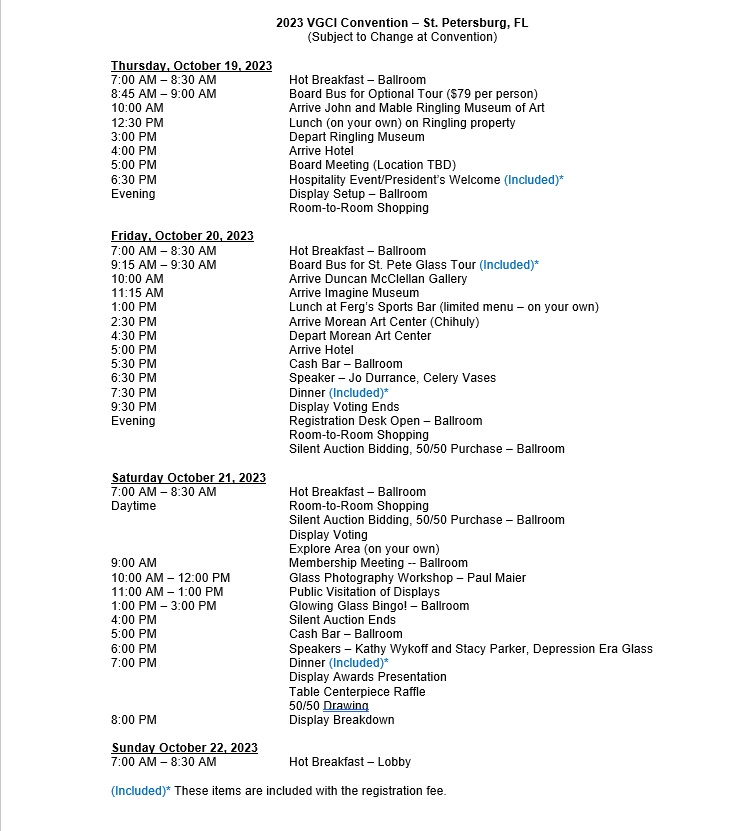
Privileges of Membership:
JOIN NOW!
CLICK
HERE
for
a membership
application
form
All information and photos on this
website are under copyright protection (1999-2006) and may only be used
by giving credit to Vaseline Glass Collectors, Inc and this
website. We appreciate the fact that some people may want to use
this website for informational sharing or for commercial uses, but we
insist that credit be given for the extensive research that has been
done to make this information available. Any and all photos on
this website are used with permission of the original
photographers. None of the glass shown on this website is for
sale.
Some of the text regarding glass manufacturers came from:
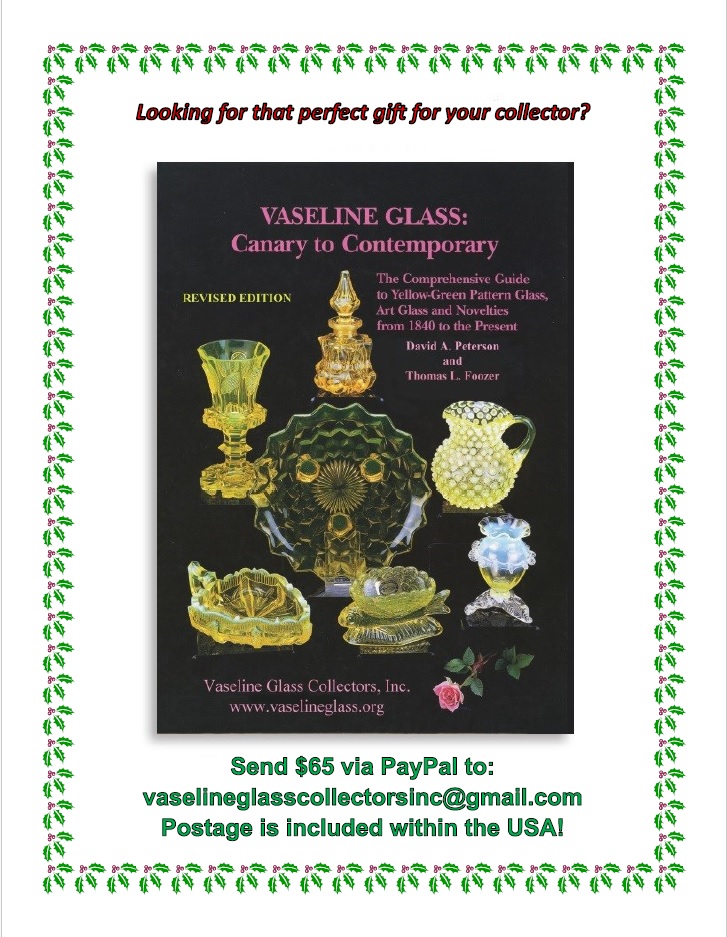
VASELINE GLASS: CANARY TO CONTEMPORARY, By David A. Peterson, copyright 2002 by The Glass Press, Inc. dba Antique Publications, P.O. Box 553, Marietta OH 45750-0553.
IF YOU HAVE READ THIS FAR ON THIS WEBPAGE, YOU OBVIOUSLY ARE INTERESTED IN VASELINE GLASS. WHY HAVEN'T YOU JOINED OUR CLUB YET?